https://mileswmathis.com/phoenper.pdf
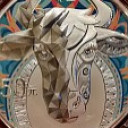
Das soll Apis sein, der ägyptische Gott, mit seiner Sonnenscheibe. Aber er und Ra sind nicht die einzigen
mit dieser seltsamen Sonnenscheibe gefunden. Auch die Sherdan haben sie, ebenso wie Ba'al. Bei Ba'al ist sie
ist sie manchmal eine Kugel statt einer Scheibe. Bei den Schnitzereien der Sherdan in 2D sieht sie eher wie eine alte Fernsehantenne
Antenne aus und nicht wie eine Sonnenscheibe. Daher rührt die Idee des Halos. Wir werden uns
in einer zukünftigen Arbeit genauer betrachten.
Mal sehen, wer hatte noch Hörner auf seinen Helmen? Die Wikinger.
Um einige drittklassige Irreführungen zu diesem Thema zu sehen, können Sie auf History.com gehen, einer Fassade für die üblichen
Leute. Dort wird uns von Elizabeth Nix versichert, dass die Wikinger KEINE Hörner auf ihren Helmen hatten.
Hier ist die Gesamtheit ihrer Gegenbeweise:
Tatsächlich ist nur ein einziger vollständiger Helm aufgetaucht, der eindeutig als „Wikinger“ bezeichnet werden kann.
Das 1943 auf dem Hof Gjermundbu in Norwegen entdeckte Artefakt aus dem 10. Jahrhundert hat eine runde
Jahrhundert eine runde Eisenkappe, einen Schutz um die Augen und die Nase und keine Hörner.
Aufgrund einer einzigen Probe sollen wir also glauben, dass die Hypothese widerlegt ist? Und sollen wir wirklich
sollen wir wirklich glauben, dass in der Geschichte nur ein einziger Wikingerhelm gefunden worden ist? Ach was! Für wie dumm
denkt sie, dass wir dumm sind? Dann gibt sie zu, dass die Wagnerianer im 19. Jahrhundert ihre Darstellungen auf
Wagnerianer ihre Darstellungen auf kürzlich entdeckte, tatsächlich gehörnte Helme aus dieser Zeit und diesem Ort stützten, aber wir können sicher sein, dass diese Helme aus der Zeit vor den
den Wikingern. Tatsächlich? Die Helme waren also datiert?
Übersetzt mit http://www.DeepL.com/Translator (kostenlose Version)
That is thought to be Apis, the Egyptian god, with his solar disk. But he and Ra aren't the only ones
commonly found with that curious solar disk. The Sherdan also have it, and so did Ba'al. With Ba'al it
is sometimes a sphere instead of a disk. With the carvings of the Sherdan in 2D, it looks like an old TV
antenna rather than a solar disk. This is where the idea of the halo came from. We may look more
closely at that in a future paper.
Let's see, who else had horns on their helmets? The Vikings.
To see some third-rate misdirection on this topic, you may go to the History.com, a front for the usual
people. There we are assured by Elizabeth Nix that the Vikings did NOT have horns on their helmets.
Here is the entirety of her evidence against:
In fact, only one complete helmet that can defnitively be called “Viking” has turned up.
Discovered in 1943 on Gjermundbu farm in Norway, the 10th-century artifact has a rounded
iron cap, a guard around the eyes and nose, and no horns to speak of.
So, based on one sample, we are supposed to believe the hypothesis is disproven? And are we really
supposed to believe that only one Viking helmet has been found in all of history? C'mon! How stupid
does she think we are? She then goes on to admit that 19th c. Wagnerians based their depictions on
recent discoveries of actual horned helmets from that place and time, but we are assured these predated
the Vikings. Really? So, the helmets had dates on them? That's convenient. Just so you know, you
can't carbon date recent metal artifacts, because they don't contain carbon and aren't old enough. They
generally have to be dated by where they were found. So this claim that they predated the Vikings is at
best wild conjecture and at worst the usual boohockey.
Amazingly, she then admits that Greek and Roman historians reported Northern European warriors
wearing horns, wings and antlers, but that is dismissed thusly:
not only did this headgear fall out of fashion at least a century before the Vikings appeared, it
was likely only donned for ceremonial purposes by Norse and Germanic priests.
But wait, didn't Nix just admit Norse priests wore horns? That's good enough for me. Plus, the first
part of that sentence doesn't even make any sense. How does she know what was in fashion then? And
how did the Vikings “appear”? They weren't there one year and suddenly they were there the next?
After a few centuries of Norwegians wearing horns as fashion, suddenly they quit and then started
calling themselves Vikings? I can't make sense of this, can you?