Beiträge von Blue Horseshoe

    must read artikel von pepe escobar.

    bitte selbst übersetzen.. mit jedem besseren browser ja heutzutage bei bedarf kein problem mehr.


    China, Russia and Iran will take the fight towards a more equal and just system to the next level, Pepe Escobar writes.


    Year of the Dragon: Silk Roads, BRICS Roads, Sino-Roads
    China, Russia and Iran will take the fight towards a more equal and just system to the next level, Pepe Escobar writes. ❗️Join us on Telegram, Twitter ,…
    strategic-culture.su


    As we enter incandescent 2024, four major trends will define the progress of interconnected Eurasia.

    1.Financial/trade integration will be the norm. Russia and Iran already integrated their financial message transfer systems, bypassing SWIFT and trading in rials and rubles. Russia-China already settle their accounts in rubles and yuan, coupling immense Chinese industrial capacity with immense Russian resources.

    2.The economic integration of the post-Soviet space, tilting towards Eurasia, will predominantly flow not so much via the Eurasia Economic Union (EAEU) but interlinked with the Shanghai Cooperation Organization (SCO).

    3.There will be no significant pro-Western inroads in the Heartland: the Central Asian “stans” will be progressively integrated into a single Eurasia economy organized via the SCO.

    4.The clash will become even more acute, pitting the Hegemon and its satellites (Europe and Japan/South Korea/Australia) against Eurasia integration, represented by the three top BRICS (Russia, China, Iran) plus the DPRK and the Arab world incorporated to BRICS 10.

    On the Russian front, the inimitable Sergey Karaganov has laid down the law: “We should not deny our European roots; we should treat them with care. After all, Europe has given us a lot. But Russia must move forward. And forward does not mean to the West, but to the East and the South. That is where the future of humanity lies.”

    And that leads us to the Dragon – in the Year of the Dragon.

    The Mao and Deng road maps

    There were a whopping 3.68 billion Chinese trips by rail in 2023 – an all-time record.

    China is fast on the way to become an AI global leader by 2030. Tech giant Baidu, for instance, recently released Ernie Bot to rival ChatGPT. AI in China is expanding fast on healthcare, education, and entertainment.

    Efficiency is the key. Chinese scientists have developed the ACCEL chip – capable of performing 4.6 quadrillion operations per second, in comparison to NVIDIA’s A100, which delivers 0.312 quadrillion operations per second of deep learning performance.

    China graduates no less than one million more STEM students than the U.S., year after year. This goes way beyond AI. Asian nations always reach the top 20% in science and mathematics competitions.

    The Australian Strategic Policy Institute (ASPI) may be lousy on geopolitics. But at least they did a public service showing nations that lead the planet in 44 critical technology sectors.

    China is number one, leading on 37 sectors. The U.S. leads on 7. Everyone else leads zero sectors. These include Defense, space, robotics, energy, the environment, biotechnology, advanced materials, key quantum technology and of course AI.

    How did China get here? It’s quite enlightening today to revisit a 1996 tome by Maurice Mesner: The Deng Xiaoping Era: An Inquiry into the Fate of Chinese Socialism, 1978-1994.

    First of all, one needs to know what happened under Mao:

    “From 1952 to the mid-1970s, net agricultural output in China increased at an average per annum rate of 2.5 percent, whereas the figure for the most intensive period of Japan’s industrialization (from 1868 to 1912) was 1.7 percent.”

    Across the industrial sphere, all indicators went up: steel production; coal; cement; timber; electric power; crude oil; chemical fertilizers. “By the mid-1970s, China was also producing substantial numbers of jet airplanes, heavy tractors, railway locomotives, and modern oceangoing vessels. The People’s Republic also became a significant nuclear power, complete with intercontinental ballistic missiles. Its first successful atomic bomb test was held in 1964, the first hydrogen bomb was produced in 1967, and a satellite was launched into orbit in 1970.”

    Blame it on Mao: he transformed China “from one of the world’s most backward agrarian countries into the sixth-largest industrial power by the mid-1970s.” On most key social and demographic indicators, China compared favorably not only with India and Pakistan in South Asia but also with “’middle-income’ countries whose per capita GNP was five times that of China.”

    All these breakthroughs laid down the path for Deng: “The higher yields obtained on individual family farms during the early Deng era would not have been possible had it not been for the vast irrigation and flood-control projects – dams, irrigation works, and river dikes – constructed by collectivized peasants in the 1950s and 1960s.”

    Of course there were distortions – as the Deng drive produced a de facto capitalist economy presided by a bureaucratic bourgeoisie: “As has been true of the histories of all capitalist economies, the power of the state was very much involved in establishing China’s labor market. Indeed, in China a highly repressive state apparatus played a particularly direct and coercive role in the commodification of labor, a process that has proceeded with a rapidity and on a scale that is historically unprecedented.”

    It remains an inextinguishable source of debate to what extent this fabulous economic Great Leap Forward under Deng generated calamitous social consequences.

    ...

    ..

    .
    watss patent in kanada an moltex erteilt.

    Advanced Reactors / Canada Grants Patent For ‘Innovative’ Spent Nuclear Fuel Recycling Process

    A patent has been granted in Canada for advanced nuclear power company Moltex Energy Canada’s spent nuclear fuel recycling process that converts uranium oxide fuel into molten salt reactor fuel.

    Invented by Moltex co-founder and chief scientist Ian Scott, the innovative process is known known as “waste to stable salt”, or Watss.

    In the process, spent nuclear fuel is converted into several parts. Transuranics – the long-lived, man-made elements – along with some uranium and fission products are extracted into a salt which forms the fuel for Moltex’s under-development stable salt reactor-waste burner (SSR-W) plant, avoiding the need for high-purity separations.

    Moltex’s 300-MW SSR-W and some other reactors can use this fuel, converting it to clean energy while destroying these long-lived waste products created by nuclear fission, Moltex said.

    The New Brunswick-based company said recently that rigorous experiments had demonstrated the viability of its Watss process.

    Moltex says its process is notable because conventional spent fuel reprocessing is complex and expensive. “Conventional reprocessing either directly produces pure plutonium, or can be altered to produce pure plutonium, which could be misused for nefarious purposes,” the company said.

    “In contrast, the Watss process is unable to produce pure plutonium, making the process far safer for current and future generations. This also makes the process simpler and less expensive.”

    Moltex chief executive officer Rory O’Sullivan said the patent is testament to Moltex’s commitment to innovation and to finding improvements in existing nuclear energy processes.

    “Waste is one of the most important considerations in the nuclear industry, and Moltex’s process offers an elegant and cost-effective solution to safely reducing waste stockpiles.”

    Moltex has been chosen by NB Power to develop its reactor technology in New Brunswick, Canada, with the goal of deploying first-of-a-kind SSR-W, Watss and GridReserve units at the Point Lepreau nuclear station site. GridReserve is a thermal energy storage tank, also under development by Moltex, enabling the SSR-W to act as a peaking plant. https://www.nucnet.org/news/ca…ecycling-process-1-5-2024

    conversion steigt weiter, als zweites glied in der kette des brennstoffkreislaufs ein wichtiger indikator


    100.000 kgu / q1-2024 alle preise aus dem ask


    conversion 60$

    uf6 310,75$

    swu 162$


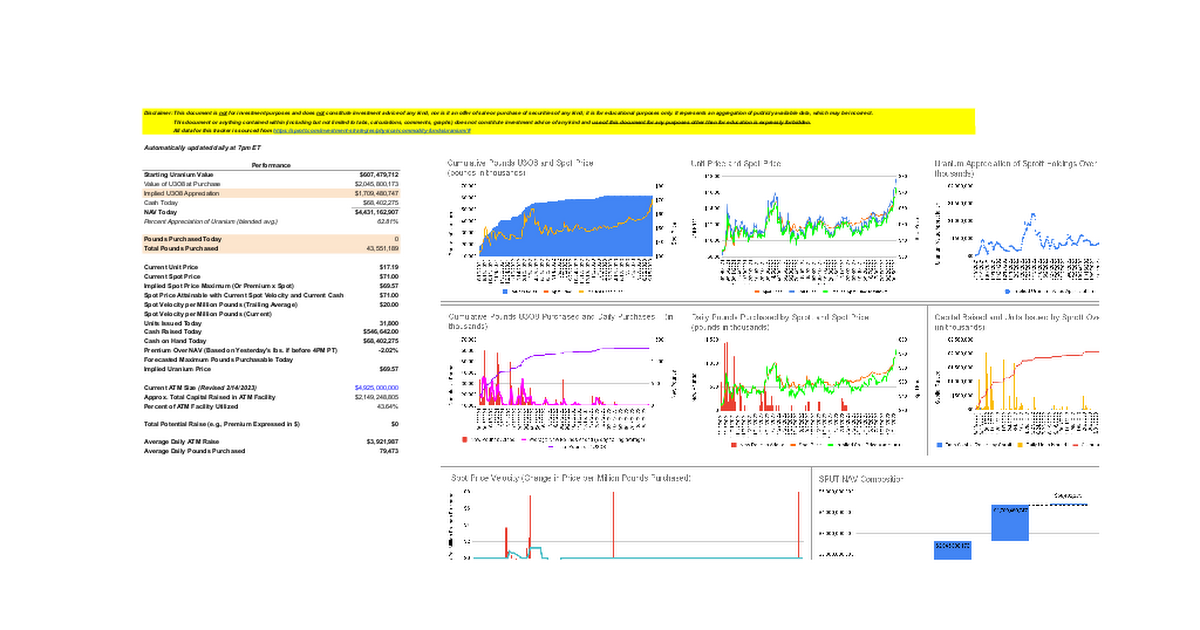
    sput

    SPUT Tracker
    Summary Disclaimer: This document is not for investment purposes and does not constitute investment advice of any kind, nor is it an offer of sale or purchase…
    docs.google.com


    +100.000 lbs

    2.340.000 neue share ausgegeben für 56.000.000$

    62.900.000$ cash

    Aber: dann hast Du sicherlich auch all die Jahre der Schmerzen ertragen (müssen)

    warum entspricht bei dir ein "Wer hatte da noch Interesse" gleich im markt dauerhaft investiert zu sein? mit der übernahme von hathor(roughrider) durch rio war ich fast komplett raus aus dem sektor und die erste position habe ich einige jahre später wieder gekauft.

    zusätzlich konnte man gerade bei zb uec die vola sehr gut traden. auf meiner core position bei uec habe ich einen ek von ca 0,5€.

    brauchst nur mal meine posts seit meinem forenbeitritt in den uranfäden lesen..


    bg bh

    all die charts und ein "angeblicher zyklus" mit angeblichem kommendem tief - und dann den (beginn) des besten uranbullenmarkt "verschlafen", der ein low risk - high yield play war.


    du wirst nie mehr zu den preisen in die beste auswahl der minen/developer/explorer reinkommen als zb. meine wenigkeit, der einfach antizyklisch kauft.


    wohin sollen denn die rohstoffpreise(strategische & energie) bei den fiskalpolitischen und währungstechnischen katastrophen und globalen verschiebungen noch fallen?


    Stocks to Commodities Ratio - Updated Chart | Longtermtrends

    das meiste an öl und gas aktien hatte ich in den uransektor umgeschichtet. jetzt habe ich einen weiteren teil meiner freilaufenden arch resources verkauft und zu einem teil in eine kleine position mcf energy und adx energy umgewandelt. sehe das als langfristiges risikoinvest ;)


    ADX Energy

    Home | MCF Energy Ltd.


    falls noch jemand einen guten input hat mit schwerpunk europa, ist er mir sehr wilkommen [smilie_blume]

    Global Atomic Corrects Uranium Sales Quantity
    Toronto, ON: Global Atomic Corporation (“Global Atomic” or the “Company”) (TSX: GLO, OTCQX: GLATF, FRANKFURT: G12) corrected the U 3 O 8 off-take sales…
    globalatomiccorp.com


    Global Atomic has formalized the Letter of Intent announced in October 2023 by signing a Definitive Agreement for the sale of up to 700,000 lbs uranium per annum from the Company’s Dasa Project in the Republic of Niger. This would represent up to 3.5 million lbs over the five-year agreement. Today’s earlier news release stated that the contract was for 350,000 lbs uranium per annum, totaling 1.75 million lbs over the five-year agreement.

    https://www.businesswire.com/news/home/20240110257559/en/


    New Found Makes First New High-Grade Discovery of 2024, Intercepts 26 g/t Au Over 7.65m & 23 g/t Au Over 5.25m at the “Honeypot Zone”

     [Blockierte Grafik: https://mms.businesswire.com/media/20240110257559/en/1994824/4/Figure_1.jpg?download=1] 

    Figure 1: Photos of mineralization, Left: at ~125m in NFGC-23-1810, Right: at ~126m in NFGC-23-1810 ^Note that these photos are not intended to be representative of gold mineralization in NFGC-23-1810. (Photo: Business Wire)


    January 10, 2024 06:30 AM Eastern Standard Time

    VANCOUVER, British Columbia--(BUSINESS WIRE)--New Found Gold Corp. (“New Found” or the “Company”) (TSX-V: NFG, NYSE-A: NFGC) is pleased to announce the results from 16 diamond drill holes that were completed as part of a drill program designed to test the newly discovered Honeypot Zone located 230m north of Jackpot on the east side of the highly prospective Appleton Fault Zone (“AFZ”). New Found’s 100%-owned Queensway project comprises a 1,662km2 area, accessible via the Trans-Canada Highway, 15km west of Gander, Newfoundland and Labrador.

    Honeypot Highlights:

    Hole No.

    From (m)

    To (m)

    Interval (m)

    Au (g/t)

    Zone

    NFGC-23-18101

    122.85

    130.50

    7.65

    26.35

    Honeypot

    Including

    123.60

    125.40

    1.80

    101.72

    Including

    126.30

    126.75

    0.45

    24.06

    NFGC-23-18281

    168.00

    182.70

    14.70

    2.05

    Honeypot

    NFGC-23-19002

    133.80

    140.00

    6.20

    6.70

    Honeypot

    Including

    133.80

    134.30

    0.50

    16.93

    Including

    134.90

    136.00

    1.10

    17.24

    And2

    146.00

    148.00

    2.00

    1.54

    NFGC-23-19312

    208.00

    213.25

    5.25

    23.05

    Honeypot

    Including

    208.75

    209.20

    0.45

    71.42

    Including

    210.10

    211.10

    1.00

    67.99

    Including

    211.80

    212.80

    1.00

    11.39

    Table 1: Honeypot Drilling Highlights

    Note that the host structures are interpreted to be steeply dipping and true widths are generally estimated to be 170% to 95% and 240% to 70% of reported intervals. Infill veining in secondary structures with multiple orientations crosscutting the primary host structures are commonly observed in drill core which could result in additional uncertainty in true width. Composite intervals reported carry a minimum weighted average of 1 g/t Au diluted over a minimum core length of 2m with a maximum of 4m consecutive dilution when above 200m vertical depth and 2m consecutive dilution when below 200m vertical depth. Included high-grade intercepts are reported as any consecutive interval with grades greater than 10 g/t Au. Grades have not been capped in the averaging and intervals are reported as drill thickness.

    • 26.4 g/t Au over 7.65m in NFGC-23-1810, intersected at a vertical depth of 91m, and 23.1 g/t Au over 5.25m in NFGC-23-1931, located a further 100m down-dip, are part of a new discovery called Honeypot that was found along the east side of the AFZ, 230m north of Jackpot and 1.3km north of Lotto. This discovery was made as a result of a follow-up drill program testing a mineralized fault that was initially identified by grid drilling (Figures 1-4).
    • Gold found at Honeypot is hosted within a primary fault that has been drill-defined over a strike length of 280m and to a depth of 190m. The high-grade domain shows good continuity and appears to strengthen at depth.
    • Honeypot has a similar east-northeast striking and steeply dipping orientation to the neighbouring Jackpot Zone and ongoing drilling is targeting its expansion along strike and to depth.

    Melissa Render, VP of Exploration of New Found, stated: “Our first pass grid drilling reconnaissance program working north of Jackpot intersected a near-surface, brittle fault with characteristics similar to the other epizonal high-grade gold-bearing faults found along this segment of the AFZ. In following this structure to depth, we are finding that Honeypot is delivering encouraging high-grade results over significant widths. There is limited drilling in this area and we are eager to expand upon these high-grade results as we kick off our 2024 drill program.”